Check Out Out Perfect Game Kid's Party Package!


2 Hours of Bowling + Shoe Rental
Unlimited Soft Drinks
Potato Chips + Popcorn
Cheese Pizza
Chicken Tenders & Fries
Invitations
Personalized Birthday Cake
Signable Bowling Pin for Birthday Child
Glow Necklaces

Our Pre Game X Package


Book your pre-game party at Jillian's & Lucky Strike Lanes where the fun is always affordable and the action is non-stop!

Check Out Our Rack 'Em Up Pool Package!


Our Rack 'Em Up Party Package Includes:

2 Hours of Pool
Chicken Skewers with Dipping Sauce
Spinach & Cheese Dip with Toasted Pita
BBQ Chicken Bites with Ranch Dipping Sauce
Fresh Baked Chocolate Chip Cookies 
"V-Strap" Women's Bowling Shoe From Dexter
Don't like tying your bowling shoes? No problem, with the V-Strap from Dexter. Easy on and off, fully fabric lined, and S6 microfiber slide pads on both feet.

You'll Love the "Lucy" Bowling Shoe from Dexter

In addition to being designed for performance, the "Lucy" bowling shoe from Dexter is one of the coolest looking bowling shoes around. It features traditional bowling shoe styling in a fabulous black and white combination, and is also offered in navy.
Dexter's "Raquel" Bowling Shoes for Women
For the crispest, cleanest bowling shoe of the bunch, check out the Raquel III from Dexter. Featuring an all white upper with light blue trim, these athletic style bowling shoes have microfiber slide soles on both shoes.
Brunswick Bowling "Tigris" - Not a Traditional Choice
With two orange stripes and riveted eyelets, the sporty "Tigris" looks quite like an athletic shoe. Man-made uppers, padded tongue and collar, and microfiber slide soles on both shoes are the tech specs. The fashion specs are: also available in delicious lime green.
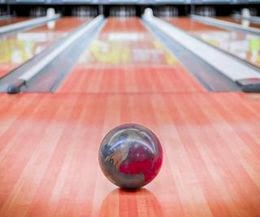
Cherry is a hardwood with a closed and straight grain with a glowing reddish-brown color that darkens with age and exposure to sunlight. Cherry wood is favored by cabinet-makers because it resists warping, it’s strong, but light in weight, and is considered one of the most beautiful decorative woods. The wood resists shock well, a good property for flooring in bowling alley lanes, since the balls used in this sport are extremely heavy, weighing up to 16 pounds.


Pine is a softwood with straight grains, a uniform texture and is white or pale yellow in color that darkens to a deep orange shade with age. Pine trees grow in North America from British Columbia to California and Utah. The western white pine, one of over 100 species of pine, was discovered and named by explorer David Douglas in 1831. Pine is one of the favorite woods used by carpenters because it’s easy to work with, either hand or power tools, resists shrinkage, is reasonably strong (but not as strong as hardwoods) and resists decay. According to Ruth Midgley, author of the definitive sports guide, “The Rule Book,” (Griffin, April 1987) pine boards make up the mid-lane area of bowling alleys. She says, “The first 12 feet of all wooden lanes is made of maple, the next 46 feet is made of pine and the pin deck is made of maple."


Maple is a hardwood with a closed, even grain and fine, uniform, texture. Colors vary from light, red-brown heartwood to darker, banded late-wood and white sap-wood. Of the 115 different species of maple, two types are grown commercially in the U.S.: soft maple, such as red and silver, and hard maple, which includes sugar and black maple. Maple is used to make floors for sports halls and bowling alley lanes because of the extremely durable nature of the wood, the characteristic of resisting shock (e.g. when a bowling ball impacts the lane) and dense nature which permits the frequent refinishing practiced by bowling centers. Bowling centers construct lanes from heavy maple boards, each weighing approximately 400 pounds, in tongue and groove sections which are nailed and glued together. Usually, the first 12 feet of any lane, including the area a player stands on, are made of maple.


How Bowling Balls are Made

 Between the early 1800s and the early 1990s, most bowling balls were made of three-piece construction. A small amount of dense material was poured into spherical core mold to create a pancake-like core. Then the remainder of the core mold was filled with a less-dense core material. Finally, the core was centered in a mold and a layer about 1 in (2.54 cm) thick of coverstock was poured around it. Since being pioneered by manufacturer Faball Inc. in the early 1990s, a two-piece construction method has become more popular.
Making the core

    1 For the particular model of ball being manufactured, a mold is formed to the core shape developed during the computerized design process. The appropriate material is poured into the core mold and allowed to harden. The solid core is removed from its mold.
    2 A second step may be necessary to finish the core. For example, some ceramic cores are fired in a kiln. A compound core may be formed by inserting the first core into a second mold and pouring material of a different density around all or part of it.


Forming the shell

    3 The finished core is placed inside a spherical mold called the coverstock
    Some examples of bowling bowl core shapes are lightbulb, spherical, and elliptical. Combination cores are made by enclosing a core of one shape and density within a second core of another shape and density. The main core may be supplemented by adding a collar or weight block to the core or by embedding small counterweights separately in the interior of the ball
    Some examples of bowling bowl core shapes are lightbulb, spherical, and elliptical. Combination cores are made by enclosing a core of one shape and density within a second core of another shape and density. The main core may be supplemented by adding a collar or weight block to the core or by embedding small counterweights separately in the interior of the ball
    mold. The core is attached to a pin that projects inward from the shell of the mold. The pin holds the core in the correct position. If the pin points toward the center of the mold, the core is said to be pin in; if it is tilted away from the center, the core is pin out.
    4 The coverstock material is poured into the mold, encasing the core, and is allowed to harden. The thickness of the coverstock may be as little as 1 in (2.54 cm) or as much as 2 in (5.08 cm), depending on the design of the particular ball.

Filling the gaps

    5 When the ball is removed from the coverstock mold, there is a hole where the core-holding pin had been. A plastic dowel is inserted into the hole and cemented in place. The pin is a different color than the coverstock. After the ball has been purchased, the pin will be used as a guide for positioning the finger holes to take advantage of the core design.
    6 Fill material is added to the logo imprint that was molded into the ball. This may be the same color as the pin, or it may be a different color. The logo is located at the top of the ball, that is, above its center of gravity.

Finishing

    7 The ball is finished to the proper size specification by turning it on a lathe and shaving off enough coverstock to achieve the right shape or it may be done on a centerless grinder that scours the ball into the desired size and roundness.
    8 Finally, the surface of the ball is finished to the desired texture. It is sanded to either a matte finish or to an appropriate degree of polish, indicated by the roughness of the sanding material (generally ranging from 240-600 grit).
    9 The ball is boxed and shipped to the company's distributor.


Bowling Pin Shape


Bowling originated in Europe where it was called keggling. It came to the United States with early immigrants. The earliest bowling pins were made of maple and were smaller than the pins of today, similar in size to the current candlepins. These pins were cylindrical, much like a rolling pin. Early American bowlers began, probably for a little variety, to turn the pins on their lathes. It became obvious that this new shape could improve pin action, the very desirable effect of one pin knocking down another. This was studied and some standardized dimensions resulted. The majority of the weight of the pin was to be in the belly or the widest part of the pin. The belly was to be the same height off the lane as the maximum circumference of the bowling ball. Some weight in the head of the pin improved the spinning of fallen pins creating better scores. From that evolving process came the very regulated product today. Pins are 15 inches high and 15 inches around at the belly. Regulation pins weigh between 3 pounds 6 ounces and 3 pounds 10 ounces, with the PBA pros using the heaviest pins. The pins are still made of maple though they are laminated. Four smaller pieces of maple are affixed to a larger central plank which has two holes or voids drilled in the area which will become the belly. This allows for better control of the weight of the pin. The pin is turned to size on a lathe and a plastic collar is attached to the base. The pin is then coated with a protective plastic covering. Very rigorous quality control is part of the release process for new pins. Since 1962 there have been 40-50 proposed modification but none has passed the performance criteria. In 1999 after three decades of research a new, all synthetic pin called the Twister was approved for use. It will debut at the 2001 ABC tournament in Reno, Nevada. Look for it; it may soon appear in your local bowling house but it probably won't make the 7-10 split any easier to pick up!

Gift Cards

Perfect Holiday gifts! Order a Jillian’s/Lucky Strike gift card online or purchase one in person today!


Lucky Strike Lanes Third Floor

The centerpiece of Lucky Strike Lanes 25,000 square feet of space are the 16 pristine bowling lanes lit up in colorful lights and highlighted by a headboard 80′ by 10′ video wall, easily customized to your presentation requirements.

With a bar on the far left flanked by a mosaic of hi-def and plasma screens catching all the days sports action, Lucky Strike can serve up food for nearly any size crowd.

Plus, with two optional private rooms for buffet service, or gaming on 12 pool tables, Lucky Strike has the perfect combo of space and activities to create a real crowd pleaser.


Are you spending your free time fundraising? We want to help you!

Jillian’s/Lucky strike Boston loves to give back to our community. Raise funds for the non-profit organization of your choice and we’ll provide the space for an unforgettable event!

Choose from one of 2 standard fundraising packages:
Bowling Fundraiser

    2 hours of bowing for up to 40 guests (includes shoe rental)
    2-4 reserved lanes
    Chips & Salsa Platter

Billiard Fundraiser:

    2 hours of free pool for up to 25 guests
    5 reserved billiard tables tables
    Appetizer platter (chips, salsa and buffalo wings)


The Fine Print

Parties must be booked in advance

Parties are available Monday through Friday from 6-8pm

All fundraiser organizers and guests must be 21+

Does not include private space

One fundraiser per person, per year

Subject to availability, not available in December

Bill Starbuck
Executive Chef of Jillian’s/Lucky Strike

Lucky Strike Lanes Corporate Executive Chef, Bill Starbuck’s culinary expertise has revolutionized bowling cuisine. Before joining Lucky Strike full time, Bill was Vice President of Catering and Corporate Executive Chef of Along Came Mary Productions where he has worked for the past 23 years. He has planned and executed the menus for hundreds of Hollywood’s “A list” movie premier parties including Titanic, Spiderman, and Superman.  He has also prepared food for the 2,000 guests at the Emmy’s as well as for 6,000 people at numerous Grammy events. He has catered many celebrity weddings, including Brad Pitt and Jennifer Aniston, as well as Barbara Streisand.

Bill worked with Steven and Gillian Foster on the menu for the first Lucky Strike in 2002 and has gone on to cater every Lucky Strike opening across the country.